
 Photograph ©Tom Pietrasik 2009
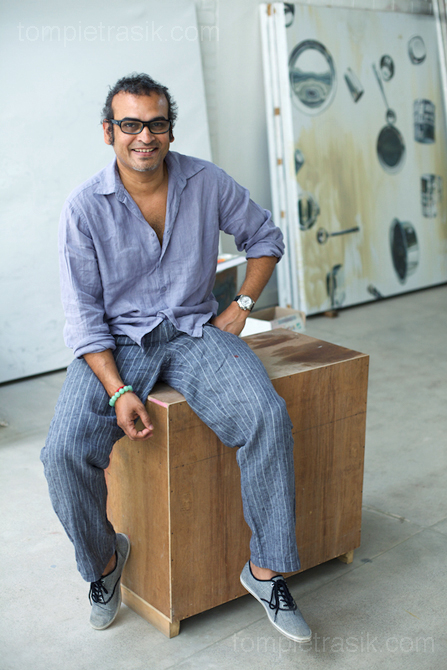
In July I was commissioned to take photographs of artist Subodh Gupta for a profile that was published in last Saturday’s Review section of the London Times (see above).
In the past twelve months I have been approached by three publications: America’s Art&Auction, the German ART Magazine and now The Times to illustrate features on the theme of Indian contemporary art. This alone is some measure of the recent international recognition bestowed upon Indian artists including Gupta who I have now photographed on two occasions. You can see my story on Indian art curators, commissioned by Art&Auction, on my website here.
Haryana, India ©Tom Pietrasik 2009
Those that know about art will appreciate the significance of Subodh Gupta and particularly his contribution to contemporary sculpture. Gupta was brought up, one of six children, to a railway-worker father in a north Indian village so his modest roots stand in stark contrast to the decadent lives of the investors that now flock to his shows. Given the scale of his success – and despite a propensity for wearing ostentatious glasses – I have been reassured to find Gupta a modest and unassuming man on the occasions we have met in his Gurgaon studio on the outskirts of Delhi. I can only assume that a childhood spent without wearing shoes and a long apprenticeship that included a stint as a newspaper illustrator together with five years acting in a regional theatre group have provided the artist a steady grounding.

Subodh Gupta and his artist wife Bharti Kher in his Gurgaon studio.
Haryana, India ©Tom Pietrasik 2009
Subodh Gupta and his artist wife Bharti Kher in his Gurgaon studio.Haryana, India ©Tom Pietrasik 2009

Hi
Its good of you to post this article on your blog… enjoyed reading it.
What perplexes me the most is to watch how the pricing of Subodh Gupta is going to shape up in the years to come…
There was this huge escalation in his prices and then there was a sudden slump..
I hope the art market recovers soon for the better
Kind regards
Harssh Shah
iv nvr seen subodh’s work,but wat i read of him touched me …im an artist myslf, an actor ..i come from a small town in utter pradesh,nd i can relate nd empathise with all that he must hv had to endure…nxt time im in gurgaon i wd definitely visit his studio ..if he lets me!! ..i love paintings nd only regret in my life is that i cant paint myself…khai,khuda ,or whoever ,aapke brush ko de zor aur zyaada …aur zyaada
Subodh Gupta is literally monotonous. Once an artist sells everybody starts singing hymns to him. It speaks volumes on the contemporary art market when you see mediocrity celebrated. Bharti Kher is even more mundane but look at the prices. Her claim to fame : a new medium of expression : the Indian Bindi. How ridiculous ! Anybody who knows the art market will tell you how the internals of this narrow and clique ridden market work. The test of art, any art, is in longivity, not temporary name and fame..